|
|
The author in the LMI warehouse. |
Alternative to What?
At Luthiers Mercantile International we offer over 40
species of wood for use in the construction of stringed instruments.
We hear the term alternative tonewood bandied about
quite often and are fond of it ourselves, but what exactly
does it mean? Alternative to what, and why?
|
LMI Sales Manager Chris Herrod chimes in with Bob Taylor and Chris Martin about the future of tonewoods in an article by Andy Ellis that appears in the February 2008 issue of Acoustic Guitar magazine.

|
If you walk into a guitar store, chances are you'll see
a variety of wood grains on the instruments displayed there.
The first thing we need to do here is to establish our bias
against the majority of cheap, often imported guitars that
use veneers instead of genuine tonewoods. A veneered guitar
is one that is made out of very thin plywood to which an
even thinner layer of veneer is attached in order to make
the guitar look good.
Typically, the veneers used are made from (or made to look
like) a traditional tonewood, though occasionally you'll
see some rather outrageous synthetic veneers where the grain
patterns swirl around in nearly impossible ways! The manufacturers
of these sorts of guitars have come a long way in making
these instruments look nearly identical to more expensive
solid wood guitars. Because plywood can be made thinner than
in the past, plywood guitars sound better than they used
to and they are very sturdy, making them a suitable choice
for beginners.
But for the serious player, there is no real substitute
for solid wood. The main, immediate difference in sound one
hears are the numerous subtle overtones, harmonics, or partials
that color the basic tone. A solid wood guitar sounds richer,
more colorful and has it's own unique sonic character. It
is also a bit louder than most plywood guitars. No two solid
wood guitars sound completely identical. Though there are
many, many factors that contribute to the sound of an individual
guitar besides the wood (the shape of the guitar, the scale
length, bridge type -the list goes on and on), the woods
used in a guitar are probably the most discussed component
of the instrument, and they are probably the most misunderstood.
Function and Tradition
Some woods are better suited to guitar
making than others and there are two main reasons for this-
function and tradition. The physics of the guitar are rather
delicate. The strings on a steel-string guitar exert a
tremendous amount of tension on the soundboard, which the
luthier hopes to have at an ideal thickness to produce
the best tone. It's a balancing act between structural
integrity and the resonance of the soundboard. If the board
is too thin, it will warp; if it is too thick, it will
sound dead or "thuddy". Spruce
has become a popular choice for soundboards because it has
the longitudinal stiffness to support both halves of the
equation. If the instrument is built properly, the spruce
soundboard will not warp against the tension of the strings
and will also vibrate freely when the strings are plucked,
thus moving the surrounding air and creating a pleasing tone.
Other qualities determine whether a particular species of
wood is suitable for guitar making, such as stability (most
luthiers hope their instruments will last for many, many
years without repair), workability and, of course, visual
beauty. Availability is also a factor. Many desirable tonewoods
are very difficult to come by and others, such as Brazilian
rosewood, are endangered and protected by treaty. Several
species of exotic tonewoods, whether endangered or not, are
very difficult to find and import. Today's luthiery supply
houses provide an invaluable service to the craft of lutherie
by taking care of the difficult procurement, import, specialized
sawing, storing and grading of these valuable woods.
Tradition is a factor that is somewhat subservient to function.
For instance, the Martin guitar company established the American
steel-string guitar as the instrument we all know today.
Their decision to use particular woods for these early, influential
guitars was based on the factors outlined above. For instance,
rosewood was often used on many of there higher-end guitars,
simply because it functioned so well as a guitar wood. It
is resonant, beautiful, stable and so on. Rosewood was therefore
used on Martin's most sought-after, high-end models. Because
Martin had such a formative role in the development of the
instrument, rosewood became associated with high quality
in general. The strength and longevity of these associations
has engendered a tradition, though it could just as easily
have been another type of wood.
Now, some may rightfully argue that
traditions such as these are somewhat arbitrary as far
as the value of an instrument is concerned, but guitars
are cultural artifacts, and there is a lot more to them
than just their functionality as music-making devices.
Individual types of guitars are associated with periods
of history, musical styles, individual artists, whole genres
of music and they can have immeasurable sentimental value.
Whether or not a guitar is deemed "cool" or
not means a tremendous amount to those who love and appreciate
guitars. The degree to which a guitar design goes with or
against a guitar making 'tradition' has a huge affect on
our appreciation of it.
So, when we say 'alternative tonewood' what we really mean
is an alternative to the tradition of using certain
woods in guitar making; but keep in mind that rarely do these
alternative woods veer very far from the traditional, because
all these woods must be functional guitar woods. It
is best to discuss them by referring to the traditional woods,
because the traditional woods at least provide a common point
of reference.
The reasons a luthier would choose
to depart from the traditional or familiar are many. Some
luthiers have set out to carve a unique professional identity
by using a particular alternative wood. Others seek a more
environmentally responsible alternative to a wood that
is endangered. Some guitar buyers/players just want something
unique and have no interest in "old-fashioned" types
of guitars. The scarcity and expense of some traditional,
exotic woods is often an issue that will turn a builder and/or
buyer to one of the alternative tonewoods. Cost often plays
a role in one's decision. Some turn to alternatives with
an innovative or experimental bent -looking for "the
next big thing".
Common Woods
Now, there are many parts on the guitar, but most agree that it is the soundboard
(or top) and the back and sides (the latter typically made from the same
type of wood) that have the most to do with the sound of an acoustic guitar.
Visually, these are the most apparent woods on the guitar. For this reason
I will limit my discussion to just these parts.
Soundboards
Soundboards are usually constructed from one of two types of woods, cedar
or spruce. It should be mentioned, however, that many guitars have been
made from pine, fir and larch, though generally these woods are considered
poor choices as far as tone is concerned.
Western red cedar is by far the most
popular cedar used in soundboards. It is common to classical
guitars and is used in a strong minority of steel-strings.
It has a nice red-tan color that ranges from chocolate
brown to cinnamon or beige. It is well known for its pleasant
scent, which is why it is a popular choice for cigar humidors.
Tonally, it is warmer and sweeter than the spruces, with
more overtones and a weaker fundamental. It is said that
the notes have a more 'singing' quality and that the tone
is more "open".
'Openness' is a particularly interesting
characteristic. Spruce-topped guitars can sound "tight" at first
and may take some time to "open up". Normally a
spruce-topped guitar needs to be played-in for a period of
time (months, even years) before it fully opens up. Cedar
on the other hand has a shorter break-in period. A new cedar
guitar will have rich harmonics and a crispness that is somewhat
lacking in a brand new spruce-topped guitar.
The only significant alternative to cedar is redwood. Redwood
has come into its own as a legitimate tonewood. It is richer
in color than cedar with darker reds. Though similar tonally
to cedar, some say redwood is more robust, brighter and perhaps
a better choice sonically for steel-string guitars (as opposed
to nylon-stringed instruments). Unfortunately, the best redwood
comes from old-growth trees, which have been seriously diminished
by indiscriminate logging. Therefore, it is harder to come
by and a bit more expensive. Luthiers Mercantile makes sure
that the redwood we carry comes from reputable sources, but
unfortunately, this cannot be said of all suppliers.
Sitka spruce has long been the staple choice for steel-string
guitars made in the United States, though a handful of classical
builders like it as well. It is well known for its pinkish-white
color that tans nicely over the years. It imparts a strong,
focused tone with a strong fundamental, making it perfect
for flatpicking guitar styles. Adirondack spruce (a.k.a.
red spruce) is perhaps a better choice for these instruments
and, though it was used early on in the history of steel-string
guitars (notably, the highly sought after pre-war Martins)
it is now considered a high-end alternative because it is
so difficult to procure suitable logs. Its excellent stiffness
helps create an instrument with great volume, power and immediacy.
There are other spruces that differ from Sitka in that they
are a little sweeter sounding, notably Engelmann spruce from
Western Canada and blue Engelmann spruce from Colorado. These
have become popular with fingerstyle guitarists and are commonly
found on classical guitars. Blue spruce is a rare item but
has been used with great success by New Mexico luthier, Don
Musser. Canadian Engelmann, on the other hand, continues
to grow in popularity and is esteemed for its fine grain
and bright color.
When Engelmann spruce was first being discovered by luthiers,
it was touted as an inexpensive replacement for German spruce
and in fact, it has many of the same fine qualities- a robust
sound rich in harmonics with good projection. German spruce
is the wood commonly used to build instruments in the violin
family. It has an overall bright color, but with a creamy,
slightly golden cast. It is considered by many to be a premier
tonewood for both classical and steel-string guitars.
Recently, several European alternatives to German spruce
have emerged in the American market. The first is Italian
spruce and its cousin, Alpine/Italian spruce. Italian spruce
is of the same species as German spruce (picea excelsa)
but has a slightly flatter coloration (more of a basic white)
and a more focused tone. Guitars made from this wood have
a sweet, singing quality.
Alpine/Italian spruce (also picea excelsa) is similar
in tone, but varies in appearance in that it is a little
more pink/tan in color (though still basically white). Finally,
there is Ukrainian spruce from the Caucasus and Carpathian
mountains that surround the Black sea; this wood has a very
creamy, white appearance and often has wider grain than the
other European spruces. Tops made of this material are quite
stiff and offer a slightly brighter, glassier tap tone than
the other European spruces. Some will be drawn to compare
Ukrainian spruce to Adirondack spruce. It is slightly less
expensive than the other European spruces but the best tops
offer the same rich tone.
Backs and Sides
The soundboard is the main sound-producing component of the guitar and the
choice of tonewood, along with the way the top is braced and thicknessed,
has the greatest bearing on the overall tone of the guitar. The back and
sides are said to act as a "filter and amplifier" of the tone
produced by the top. The back and sides can remove or emphasize various
frequencies produced by the top, coloring the tone and affecting factors
such as tonal balance, volume, attack and projection.
The Rosewoods
For many years the crème de la crème of back and side
woods was Brazilian rosewood. Though this wood is still in common
usage, it has been protected against import and export by the CITES [Convention
on International Trade in Endangered Species of Wild Fauna and Flora] treaty
since 1991. For this reason, a number of alternatives have surfaced- one
being Indian rosewood, which in turn has become a standard choice
and should now be considered a traditional tonewood itself. It was during
the 60's that most large manufacturers switched from using Brazilian to Indian
rosewood.
Brazilian rosewood is sought after for its (usually) dark
brown color that ranges from chocolate brown, to rust or
a warm burnt orange. Finer examples feature fine black line
figuring and spider webbing (where the black lines make web-like
shapes that cross from one annular ring to another). The
tone, some say, is incomparable, though it is often argued
that this opinion is once again, a habit of tradition. Great
projection, with strong, balanced bass and highs are its
trademarks.
Indian rosewood varies quite a bit in appearance from Brazilian
rosewood, though it is still quite dark. Basically brown,
but with purple, gray and sometimes red highlights, it is
known for straighter, more homogenous grain lines and a lack
of ink-line figuring. Some say it is on par with Brazilian
rosewood for tone (a few say it is superior), and though
it is far easier to procure and less expensive, it is nonetheless
considered the mark of a higher-end instrument, especially
by manufacturers. Some say it lacks a bit of the projection
that Brazilian rosewood is known for, but this is debatable.
Other rosewoods are found in Asia, Africa and South/Central
America, offering a tremendous variety of choices for those
who like the rosewood sound. The most exotic of these is African
blackwood. Strikingly different from other rosewoods
in that it is flat black in color, and among the densest
woods found on the planet, it is also one of the most expensive.
The trees grow in isolated areas of the West African deserts
and the trunks of these trees are twisted and small, yielding
little guitar-sized wood. For those daring luthiers who don't
mind dulling their chisels on this hardest of guitar woods,
African blackwood can contribute to a rare and valuable guitar
with outstanding volume and power, given that the top is
voiced appropriately.
There are other rosewoods that compare in density to Brazilian
rosewood, such as Honduran rosewood and Amazon
rosewood. Honduran is more of a brick red/brown in color
and Amazon is similar in color to Brazilian but is usually
found with less figure. Both of these woods feature tight
grain lines and both have adherents that claim they are finest
tonewoods available.
On the wild side are: Southeast Asian rosewood, palo
escrito and cocobolo rosewood. Southeast Asian rosewood
is very hard to come by and was only available from Luthiers
Mercantile for a 4-year period during which we exhausted
the stock from a single shipment. There may still be many
good logs left but at this time, no one is harvesting them
for instrument use. The wood was very dramatic in appearance,
with brick reds, magentas and purples combining in unique
ways. Many sets also featured dramatic black line figure
and attractive sapwood centers.
Cocobolo, on the other hand, is readily available from Mexico;
this superb tonewood has bold, distinctive orange highlights
with plenty of black lines that can often show exciting swirly
patterns. Some sets are dark reddish-brown. Cocobolo is among
the heaviest of the rosewoods and is known to impart a strong
bass to guitars. Many luthiers shy away from using cocobolo
because they have an allergic reaction to it when sanding
and, because there are abundant oils in the wood, it can
be difficult to glue.
For those who can work around these problems, cocobolo is
a great favorite for both tone and beauty.
Palo escrito is a tan wood with reddish-brown lines that
create unusual patterns in some sets, much like colobolo.
This is a lighter-weight type of rosewood. Guitars with back
and sides made of palo escrito are known for a sweet high
end and good punch. This wood is becoming a popular choice
for flamenco guitars, but steel-string builders who are experimenting
with it, most notably James Goodall of Goodall guitars, are
getting excellent results with it.
Finally, from the rosewood category, there is Madagascar
rosewood. Little can be said about it that hasn't already
been said about Brazilian rosewood! Visually, it is a dead-ringer
for Brazilian, though in general it is more red or rust
colored. The main differences are that Madagascar rosewood
is not illegal to import, it is far less expensive, and
a little lighter in weight. More than a few builders claim
that the lower weight bestows an additional sonic liveliness
that surpasses Brazilian rosewood -and indeed, most other
tonewoods. The tap tone of this wood has a noticeably strong,
sustaining quality.
There are a number of other woods that, because of their
higher density, help create a rosewood-like sounding guitar,
but do not come from the rosewood family. Visually, none
of them would be mistaken for rosewood, but they are all
quite attractive in their own right. On the higher-end are Macassar
ebony and ziricote. Breedlove Guitars, a company that
has created models from numerous alternative tonewoods, is
very fond of both of these woods. Macassar ebony, as you
might guess, is a black wood but with dramatic blond streaking
which creates a beautiful liquid or marbled appearance. Ziricote
is grayish in color and features intense spider-web figuring
and layered effects.
Both woods are brittle and hard to work with. Both are expensive
but their high density allows for great tonal balance and
volume and the scarcity of well-figured sets adds value to
the instruments. The remaining rosewood alternatives, on
the other hand, are relatively inexpensive and easy to come
by. From Africa there's bubinga, which has a nice
reddish-mauve brown color and often sports an interesting
'bees-wing' figure that gives a nice three-dimensional shimmer
to wood under finish. Also from Africa is padauk.
A brilliant purple-red wood, it oxidizes to dark brown over
time. Finally, there is wenge a very dark brown wood
(verging on black) that some well-known builders, such as
Mark Blanchard, have had good results with.
From South America there is grenadillo. This wood
has a nice purple brown color reminiscent of Indian rosewood,
except that it does not have the straight lines that Indian
has. Grenadillo does have a subtle wavy figure, a bright
responsive tap tone, and attractive sapwood centers are commonplace.
It is popular in Brazil, but it is relatively new to American
lutherie. It promises to become a favorite among steel-string
builders. Pau ferro (or morado) is well known as a fingerboard
wood on electric guitars and basses and is coming into its
own as a back and side wood. It is much like Indian rosewood
with dark, straight, vertical lines except that gold, beige
and brown substitute for the dark browns, grays and purples
found in Indian rosewood.
Alternatives to Maple and Mahogany
Maple is the only wood used for backs and sides in the violin family so it
is well known to instrument makers, even though just a modest percentage
of guitars are made with it. The fact that it is a domestic wood augments
its popularity and it is often used on electric guitars, most notably the
Gibson Les Paul. Maple with figuring is preferred over plain maple, but
the figure has no real bearing on the sound of the wood. The figure is,
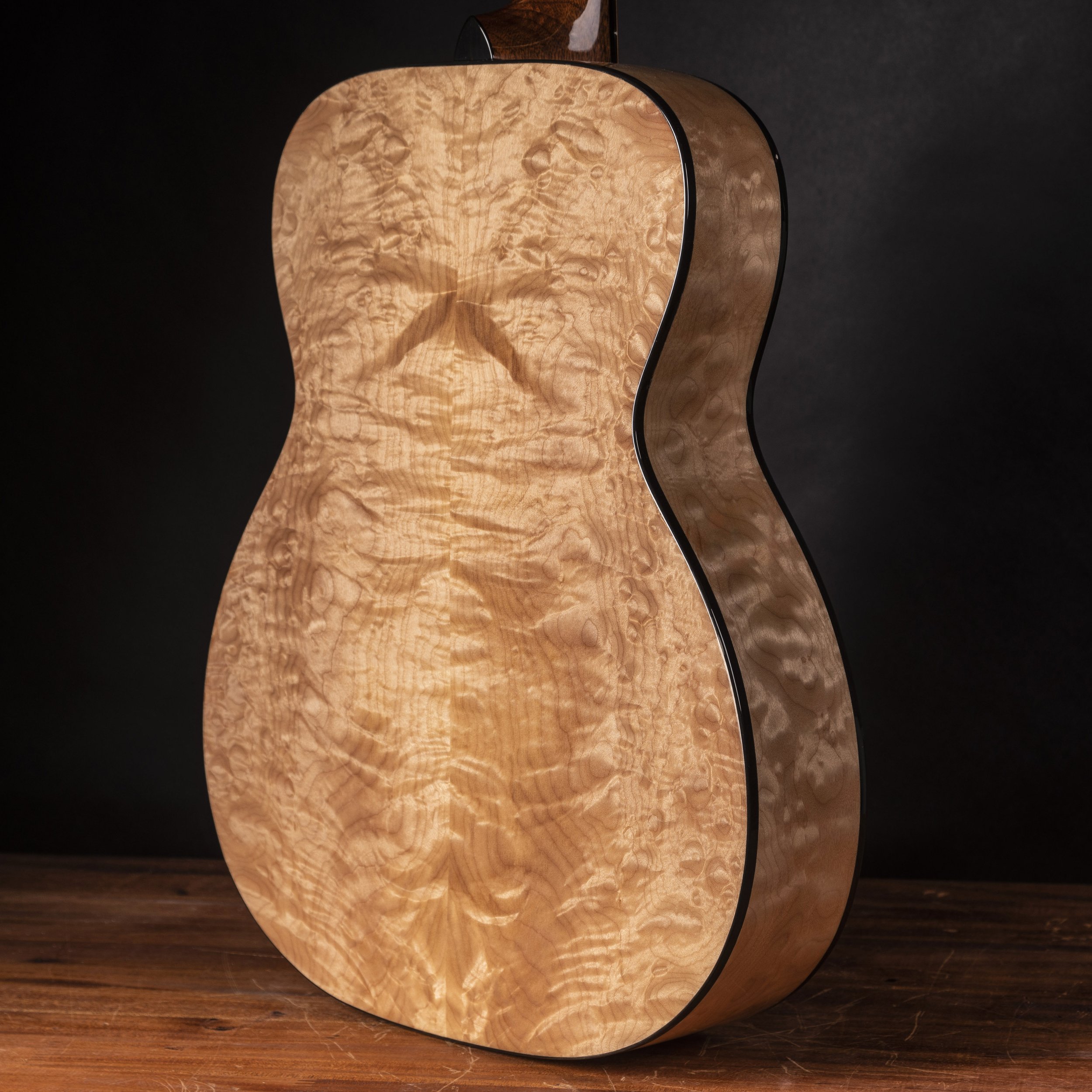
however, strikingly beautiful. Most common are curly maple (also
known as flamed maple or tiger maple) or quilted maple (a bit rarer, this
wood has a billowy, bubbly appearance). Plain maple (rock maple
from the East Coast) is often used for electric guitar necks, but bigleaf
maple (from the Northwest) and European Maple (from the former
Yugoslavia) are the common choices for acoustic guitar back and sides.
Maple is well known for imparting bright tone to an instrument,
with excellent separation (a guitar with good separation
allows each note of a chord to ring independently as opposed
to sounding thick or clustered). It has long been a popular
choice on the Gibson Jumbo series because the bright tone
helps balance out the boomyness of guitars that have
a large body.
It is hard to find an alternative to maple though tonally,
many have had similar results with Californian walnut.
Walnut is primarily dark gray in color and can also exhibit
dramatic figuring. Myrtlewood (also from the Pacific
Northwest) has many maple-like qualities in tone and appearance,
though generally the sets are more varied as far as color
is concerned, with brown, gray and greenish vertical streaks
being common.
Another set of alternatives is Hawaiian koa and its
Australian cousin, black acacia (otherwise known as Australian
blackwood). These woods are among the most beautiful.
Often found with a light, honey-brown color, they can combine
vertical color bands with flamed figure, though flamed sets
are becoming increasing more difficult to come by. Though
koa is technically not endangered, good old trees are few
and far between on the islands and prices for the best sets
are sometimes on a par with Brazilian rosewood. Koa is sometimes
compared, tonally, with mahogany, which I will discuss next.
Genuine Honduran mahogany has been an ideal choice
for a variety of woodworking applications. Its cross-grained
structure makes it unusually stable and easy to carve. It
is a superb choice for woodcarvings, furniture making and
pattern making. It is still the most popular choice by far
for guitar necks, though Spanish cedar is widely used on
classical guitars and Maple is widely used on electric guitars.
Genuine Honduran mahogany used to be plentiful but it is
now nearing CITES treaty protection. The guitar-making world
is struggling to find a suitable alternative for necks, but
there is really no clear choice. Fortunately, the use of
trussrods and graphite reinforcement in necks will allow
the luthier to accept other mahoganies that are not quite
as stable with no ill effects.
As a back and side wood, mahogany
has sometimes been considered a "poor man's choice",
but there is now a great appreciation for its unique tonal
qualities. It seems that mahogany ages well and its true
value may not reveal itself until a few years have passed.
This is especially true when it is used as a top wood (Martin
issues a mahogany-topped model from time to time). Mahogany's
trademark tone is a powerful midrange, with great punch
and character.
As far as stability is concerned, Honduran mahogany has
no peers, but tonally there are some good alternatives in
the mahogany family. The best is Sepele mahogany which features
a very attractive ribbon figure that runs parallel to the
grain. Khaya mahogany looks more like Honduran, but is generally
softer, so it is important to find dense logs when cutting
for guitar material. Outside of the mahogany species, lacewood
is the most exciting alternative. According to John Greven,
a luthier who has built hundreds of guitars in his career
and who has a great respect for vintage Martins, lacewood
has the rare ability to impart the tone of a well-aged Martin
mahogany guitar to a brand-new instrument. Fruit tree woods,
most notably cherry and pear, sometimes draw comparisons
to mahogany.
Where to Now?
As stated previously, there are many reasons why a musician might consider
buying a guitar with so-called alternative tonewoods in its make-up. I
hope I have opened a doorway into exploring these woods, but regrettably,
it is impossible to convey their unique characteristics with just a toolbox
of adjectives to work with. Each piece of wood is different and what each
individual luthier does with the wood is unique. You can read about woods
all you want, and you can tap and flex the individual pieces to test their
tonality, but you will learn far more by playing the instruments themselves.
After all, a guitar is far more than the sum of its parts and what is magical
about a particular instrument comes from none of its individual components.
So, if a luthier is building a custom instrument for you,
it's best to ask what he or she can suggest to help you meet
your musical goals. Just remember that the craftsman will
have a better idea of how to inject his or her gifts into
the instrument then you will! Keep an open mind, because
what they might suggest may surprise you. Though tradition
may direct you to select a guitar made out of this or that
wood, your dream guitar may very well be born of a unique,
and heretofore unheard of tree!
J. Chris Herrod 5/20/04
About Chris Herrod:
As sales manager for Luthiers Mercantile, Int'l. for the last seven years,
Chris Herrod has enjoyed the friendship and advice of scores of the world's
finest string instrument makers. As a guitarist who has had the unique
opportunity to play some of the world's finest and most innovative instruments,
he has garnered a deep appreciation for the varied woods he sells and the
instruments that are produced from them.
In his spare time he records and performs
as a solo singer/songwriter
and is also known to make a huge racket on the electric guitar
in various local improv combos.